

Home / News / Industry News / Anti-Bacterial Rubber Flooring for Healthcare: A Practical Selection Guide
Content
A hospital floor takes more punishment before breakfast than most commercial floors see in a week. Trolleys with sticky castors, disinfectant mopped across the surface four times a day, patients shuffling along in slippers, staff moving fast in soft-soled shoes. When something goes wrong at floor level, the consequences are rarely cosmetic — they surface as infection control findings, slip incidents and complaints about noise at night.
We have spent a good part of three decades helping healthcare clients get this one decision right, and the lessons are remarkably consistent. This guide walks through what anti-bacterial rubber flooring actually offers in a clinical setting, where it fits best, and the specification details that decide whether a floor still performs well in year eight.
A healthcare building asks a floor to do several jobs at once, and those jobs sometimes pull in opposite directions. A surface that grips well underfoot can be harder to push a bed across. A floor that cushions a fall still needs to be dense enough to resist the indentation of a bed leg standing in one spot for months.
Four pressures come up in almost every project we discuss:
Add round-the-clock traffic, beds on castors and the occasional dropped syringe, and it becomes clear why this deserves more than a single line in the finishes schedule.
Two different things get described with the same phrase, so it is worth separating them. The first is the material: dense rubber compounds are naturally non-porous and water-resistant, and they can be formulated with additives that inhibit bacterial growth on the surface. The second is the construction detail: a sheet laid with heat-welded seams and a coved skirting creates a continuous, washable surface with no grout lines and nowhere for soil to collect.
In practice, the second matters at least as much as the first. A floor with antimicrobial chemistry and a poorly welded seam is still a floor with a poorly welded seam.
A realistic way to think about it is this: the floor's job is to be cleanable, to stay dimensionally stable under repeated mopping, and to resist the wear that eventually turns a smooth surface into a scratched one where soil clings. Cleaning does the rest — which is why we always ask how a department actually cleans before recommending a surface.
Rubber also brings qualities that have nothing to do with bacteria. It is warm underfoot, quiet, and comfortable enough that staff working a twelve-hour shift notice the difference by mid-afternoon. Our seamless rubber flooring range was developed with exactly these continuous-surface projects in mind.
 OPURE Seamless Rubber Flooring for Continuous-Surface ProjectsHeterogeneous seamless rubber flooring in 36 hues, offering durable, low-maintenance, sound-absorbing performance for continuous-surface projects such as healthcare corridors and support areas.View Product →
One specification across an entire hospital is rarely the right answer. A corridor carrying beds, supply carts and visitors all day is a different problem from a sluice room that sees hot water and disinfectant every hour. The table below is the working framework we use when a project team asks where to start.
| Zone | What matters most | Practical approach |
|---|---|---|
| Main corridors and department arteries | Rolling loads, slip resistance, noise over long runs | Dense rubber sheet, welded seams, matte wear layer |
| Operating theatres and procedure rooms | Seamless non-porous surface, chemical resistance, static control | Homogeneous sheet with coved base and welded joints |
| ICUs and neonatal units | Quiet underfoot, warmth, minimal joints, rigorous cleaning | Rubber sheet, heat-welded, coved skirting throughout |
| Patient rooms and wards | Comfort, acoustics, soil hiding, ease of repair | Rubber sheet or tiles in low-gloss, mid-tone colours |
| Imaging and diagnostics | Static dissipation, smooth movement of beds and equipment | Antibacterial antistatic flooring with verified conductive path |
| Physiotherapy and rehabilitation | Grip, impact absorption, resilience under moving equipment | High-elasticity rubber with a higher wet slip rating |
| Bathrooms, sluice and utility rooms | Water, urine, disinfectant spill, frequent washing | Welded sheet, coved edges, pronounced surface texture |
| Entrances and waiting areas | Abrasion, wet feet, scuffing, visual first impression | Heavy-duty rubber backed by a proper entrance matting system |
Budget conversations usually follow the zoning exercise, so it helps to have numbers early. Our zone-by-zone healthcare flooring cost breakdown sets out material and installation ranges against the same department categories.
For imaging suites and any area where static discharge could damage equipment or unsettle staff, an antibacterial floor with antistatic performance covers both requirements in a single system rather than compromising on one.
 Rekiron Antibacterial Antistatic Heterogeneous FlooringHeterogeneous flooring combining antibacterial and antistatic performance, suitable for imaging suites and spaces where hygiene, equipment protection, and noise control matter.View Product →
No material wins everywhere, and a fair comparison helps a project team defend its choice later.
Where the budget allows only one premium surface, we usually suggest spending it on corridors and wards — the areas patients and staff spend the most time in.
Most flooring failures we are called out to inspect are installation failures wearing a material costume. Three details deserve attention from the first site visit.
Subfloor moisture. Rubber and PVC sheet are both sensitive to moisture vapour rising through a slab. Test it, record it, and specify a suitable surface damp-proof membrane where readings sit near the limit — retrofitting one later costs many times more than including it in the programme.
Welding and coving. Heat-welded seams, trimmed flush, plus a coved skirting formed over a cove fillet, give the continuous surface that infection control teams want to see. Skimping here leaves a floor that looks right on handover and disappoints at the first deep clean.
Sequencing. Rubber needs to acclimatise in the conditioned building before it is cut. If wet trades are still working nearby, the humidity will undo a careful installation. Plan the floor late in the programme, then protect it.
A floor is only as antibacterial as the cleaning it receives. Neutral-pH detergent and damp mopping handle almost everything a ward produces; strong disinfectants should be used where the protocol requires them and rinsed rather than left to dry repeatedly on the surface.
Shanghai Dajulong has been producing flooring and wall decorating materials since 1996, and today operates more than four production bases across 893,333 m² with a team of over 1,000 people. That scale matters less than what it represents: consistent batches, stable lead times, and the ability to match a corridor floor with the wall panels and coved details in the same package.
Our antibacterially oriented rubber flooring is produced in grades for slip resistance, elasticity and seam-free installation, so a specifier can hold the same visual language across departments while adjusting performance. If you would like to see how that has worked in practice, our hospital projects show the zoning approach applied to live clinical buildings.
For projects where grip and impact absorption sit at the top of the brief, the antislip scratch-resistant rubber flooring range is a sensible starting point for physiotherapy, corridors and rehabilitation areas.
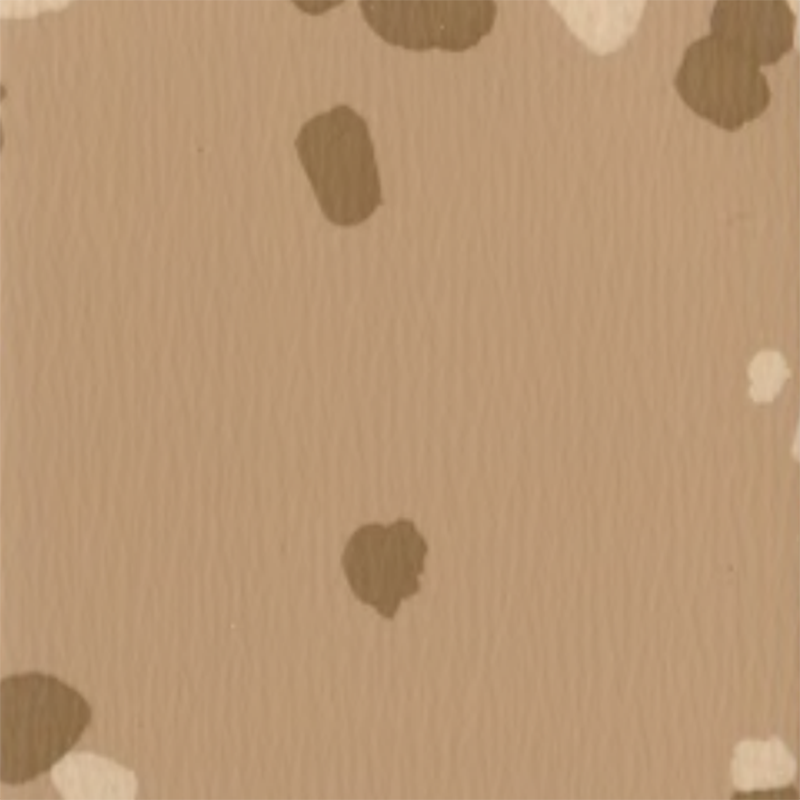 OMAY Anti-Slip Scratch-Resistant Rubber FlooringRubber flooring with anti-slip texture and scratch resistance, suited to physiotherapy, corridors, and rehabilitation areas where grip, impact absorption, and durability are priorities.View Product →
Send us your department schedule and cleaning protocol, and we will come back with a specification you can put in front of an infection control committee without needing to translate it first.



 English
 русский
 عربى
 Español