



Home / News / Industry News / LVT Thickness Guide: Choosing the Right Vinyl Tile Thickness for Your Space
Content
Thickness is the first number most people notice when they open an LVT sample folder, and it is also the most misunderstood. Two tiles can both measure 3 mm yet behave completely differently underfoot, while a 5 mm plank and an 8 mm plank are often sold as premium without anyone explaining what the extra millimetres are actually doing. This guide sets out what LVT thickness describes, how the main ranges compare, and how to match a specification to the space instead of to a label.
We have been manufacturing flooring and wall decorating materials since 1996, and today four production bases and more than 893,000 square metres of factory space stand behind our floor and wall material ranges. That background shapes what follows, because the useful answers usually come from the production line rather than from the showroom floor.
Luxury vinyl tile is a layered composite, and the total thickness is simply the sum of every layer pressed together. Knowing those layers is the quickest way to understand why one specification behaves differently from another. If the terminology is still new to you, our guide to what LVT flooring means covers the basics; the list below covers the structure.
Total thickness is normally quoted in millimetres, while the wear layer is quoted in mils or in millimetres. One mil equals 0.025 mm, so a 20 mil wear layer is roughly 0.5 mm of transparent vinyl. Confusing those two units is the most common specification error we see.
The table below summarises the ranges that dominate the market and the situations each one usually fits.
| Total thickness | Typical format | Best suited to | What the extra height buys |
|---|---|---|---|
| 2.0-2.5 mm | Glue-down flexible LVT | Bedrooms, utility rooms, light retail, renovation over sound existing floors | Lowest material cost and the thinnest possible transition height |
| 3.0 mm | Glue-down flexible LVT, the global commercial standard | Offices, schools, corridors, healthcare | Dimensional stability under rolling loads with minimal build-up |
| 4.0-5.0 mm | Thicker flexible LVT or a thin rigid core | Living rooms, hotel rooms, medium-traffic commercial interiors | Softer feel underfoot and more tolerance of small subfloor variation |
| 6.0-8.0 mm | Rigid core click, SPC or WPC | High-traffic residential, retail, spaces needing acoustic upgrades | A rigid locking profile, better impact sound figures, faster dry installation |
Two observations are worth keeping in mind. First, the spread between the cheapest and the thickest product is usually created by the core, not by the decorative layers, so a thicker tile is not automatically a longer-lasting one. Second, every range above assumes a sound subfloor; thickness compensates for minor irregularity, never for a floor that moves or holds moisture.
If total thickness describes how the floor behaves physically, the wear layer describes how long the surface will keep looking new. As a practical starting point:
On our own lines, the wear layer is specified together with the intended traffic class rather than chosen afterwards. A thick tile with a thin wear layer will still scuff early, while a slim tile with a thick wear layer can outlast it comfortably.
Thickness decisions become much easier once the room, the traffic and the maintenance routine are written down. Two situations cover most of the projects that pass through our factories.
For most residential rooms, 3 mm to 5 mm of flexible LVT glued down over a properly prepared subfloor gives the best balance of cost, comfort and stability. Where a click system is preferred, the locking profile itself needs height, so 4 mm to 6 mm rigid planks are the norm. Products designed around that logic, such as our easy-installation LVT, are built to be replaced tile by tile rather than room by room.
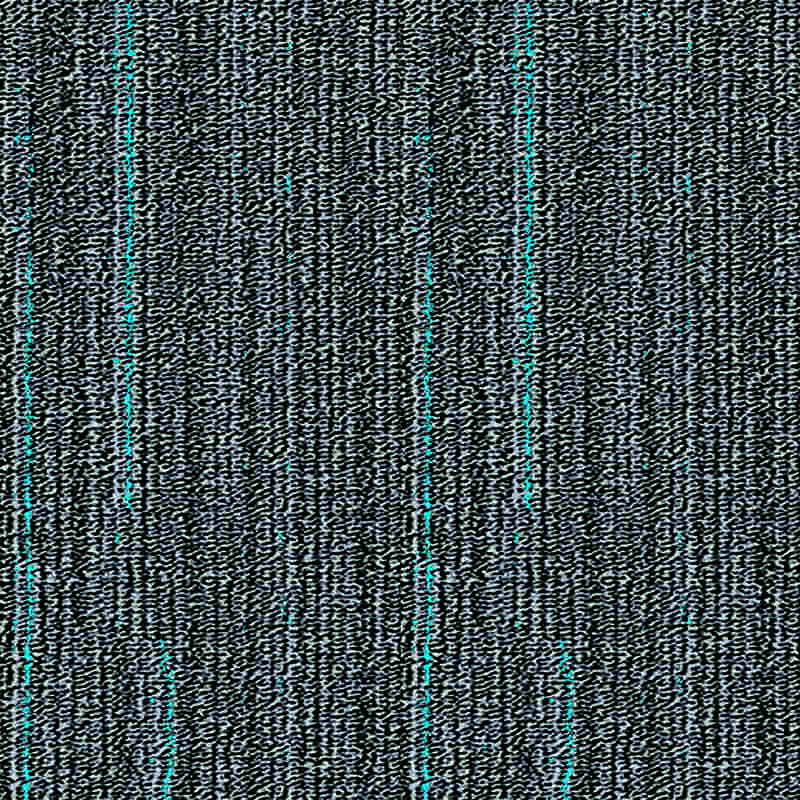 Easy installation & easy to replace luxury vinyl tilesKARMEEN's carpet-textured sheeting collection is meticulously crafted to reduce noise while enhancing walking comfort. Offering 38 patterns and seven carpet-textured d...View Product →
These spaces combine rolling loads, frequent cleaning and long opening hours. A 2.5 mm to 3.0 mm glue-down tile or sheet with a 20 mil or heavier wear layer is the standard commercial answer, because a dense, thin product transfers loads to the subfloor instead of flexing beneath furniture and trolleys.
Workshops, warehouses and production halls change the equation again. Point loads from machinery, chemical exposure and constant trolley movement push the specification towards dense homogeneous or heterogeneous vinyl constructions at 4 mm to 6 mm, or towards rubber where shock absorption matters more than flatness. Anti-static requirements add another variable, because conductive networks have to run through the core rather than sit on top of it.
In these environments the wear layer and the surface treatment do most of the work. A construction such as our wear-resistant, recyclable heterogeneous flooring pairs a tough surface with a core dense enough to stay flat under heavy traffic, which is why this product family is specified in transport hubs, hospitals and manufacturing sites.
 Wear-resistant & recyclable heterogeneous flooring1: With a 0.35mm wear layer thickness, it meets the usage requirements of high-traffic areas and is widely applicable in education, commercial, office and other fields...View Product →
One caution from the production side: industrial specifications should always be checked against the actual chemicals and cleaning agents used on site. A datasheet can confirm a class, but only the site routine confirms suitability.
SPC, or stone plastic composite, replaces the flexible vinyl core with a rigid mineral-filled one, and that single change rewrites the thickness logic. In a flexible LVT, extra millimetres add cushioning and help the tile bridge small subfloor variations. In an SPC plank, extra millimetres usually go into the core, producing a stiffer board with a stronger locking profile, better impact sound figures and a floor that can float over a wider range of substrates.
This is why comparing 3 mm LVT with 3 mm SPC is not a fair fight in either direction. The flexible product is generally glued down and relies on the adhesive and the subfloor for stability, while a rigid core such as our high-stability SPC lock flooring carries its own structural strength and needs a flat, dry base rather than a bonded one. Choose the format first, then the thickness within that format.
 High stability & high strength SPC lock flooringThis upgrade to hard flooring features a specially formulated, durable film layer that provides increased strength and dimensional stability, effectively resisting ext...View Product →
No thickness specification survives a bad substrate. Before the product is chosen, four checks are worth completing:
Get those four answers and the thickness range usually narrows itself to two or three options, which makes quoting and comparison far quicker.
When two quotations look almost identical, the difference is usually hiding in the detail. Ask for the following and compare them side by side:
A supplier who can answer all five quickly is usually one who knows the product from the inside.
LVT thickness is a useful shorthand, but it is only one line of a specification. Match the format to the installation method, match the wear layer to the traffic, and match the total thickness to the subfloor and the transition heights you have to respect. Do those three things and the number on the label becomes a confirmation rather than a guess.
If you are working on a project and want a second opinion on thickness, wear layer or format, our team is happy to look at the drawings, the traffic profile and the subfloor conditions with you. Send us the details and we will come back with a specification you can defend.






 English
  русский
 عربى
عربى Español
